

Outdoor advertising has its misconceptions, but it’s important to understand them to properly use outdoor advertising as a business. There are some misconceptions and myths that many people have when it comes to outdoor advertising, and it’s time to debunk those myths. We’ll start with one of the biggest myths associated with outdoor advertising, which is that consumers no longer pay attention to billboards. Surprisingly, outdoor advertising has changed dramatically; people are still shrouded in misconceptions about it.
It’s strange, but there is a common misconception that outdoor advertising is only an option for big brands or large corporations. It is also worth noting that OOH is an environment in which ads are displayed at 100% and reach 98% of the population every week. Since we see the same advertisements on our regular routes, it is a common misconception that outdoor advertising is used for the long term. OOH, media, and external channels such as billboards are ideal in this regard as ads can be placed in specific and strategic locations that optimize your reach in the local community and reach the largest possible audience during the campaign.
Mobile advertising combined with digital out-of-home advertising can generate high levels of store visits and app downloads. OOH, ads run much faster and easier than most marketers think. Although OOH campaigns can be launched in less than a week.
For example, while it’s easy to launch an outdoor ad campaign in less than a week with the right technology, Digital advertising is much cheaper than traditional media. Digital advertising is just as important for engagement and branding as it is for sales. However, digital advertising is an opportunity to play with big brands, unlike radio, television, and print media.
Digital advertising is an equalizer that allows everyone to bid for ad space in various markets. Outdoor advertising has great potential and is one of the most lucrative ways to promote your brand. Location is a determining factor in the price of outdoor advertising, but there are plenty of options to suit almost any budget.
When it comes to targeted advertising, outdoor advertising is beneficial for any type of business, regardless of size or brand. Billboards are only part of outdoor advertising, but their area is quite large and includes any advertising carried out outside, in the workplace, or an informal get-together. There is no doubt that digital advertising, including social media, requires investment. If you divide the investment amount by the total reach, OOH is one of the cheapest forms of advertising. A recent ad recall study showed that brands can increase exposure by using outdoor advertising, especially outdoor advertising, which has proven to be the best communication medium for advertising appeal.
Big brands mainly use out-of-home advertising.
To make sure you have a clear picture of what the world outside the home looks like today, and what value it can provide for brands of all shapes and sizes, we decided to take some time to debunk the many myths and misconceptions about home. Based on the ads we still hear so often, unfortunately. We hope that by debunking these myths, you’ll understand that digital out-of-home advertising is a great way to reach your target audience and achieve your marketing goals.
Although many of us think that out-of-home advertising is an expensive form of advertising, the cost of running an OOH campaign is much lower than you might think. A recent advertising recall study showed that brands can increase exposure by using outdoor advertising, especially digital advertising, which has proven to be the best communication medium for advertising. This factor gives OOH great potential to be incorporated into any marketing mix, not just brand advertising.
In the past, OOH advertising has been used primarily for brand marketing campaigns, where billboards adorn everything around with the brand’s most iconic ads. Billboard advertising is a traditional outdoor advertising format, but in recent years there has been a significant increase in digital outdoor advertising (digital billboards and place-based networks).
2. Billboards receive little attention.
One of the silliest OOH media myths says that no one pays attention to billboards and their primary messaging, so we’ll start there. This assertion is not supported by evidence, and the figures even show how effective billboards are in attracting customers’ attention and engaging them in meaningful conversation. For example, a startling 98% of customers see at least one billboard every single week, demonstrating the effectiveness of such channels. The last figure is crucial since it refutes the notion that billboards and OOH media can’t engage consumers and have an immediate impact on their shopping decisions.
As we saw with senior marketers who believed that advertising should grab the conscious attention of consumers at work, these and many other myths are still deeply rooted in much of today’s business world.
Advertisers often have to stop what people are doing to get them to pay attention to their ads. Many people think that the power of billboards pales in comparison to digital, social and television advertising, but this is not true. Regardless of the type of billboard used, it still attracts a lot of attention. At that time, a huge billboard was prominent enough to grab people’s attention, as there were few outdoor advertisements. Such advertisements very often fail in the market because people in real life do not perceive them with the attention that would be required to decipher the message.
3. Outdoor marketing is expensive.
Outdoor advertising (OOH) requires an initial investment, but the overall cost is much lower than other media. Outdoor advertising is notoriously expensive, but it offers the lowest cost-per-thousand-impressions (CPM) of any traditional medium. The idea that outdoor advertising is expensive comes from the cost of billboards in places like posh areas, but the place determines the price, not the medium.
The OOH mode also affects the price. OOH, media includes, for example, both digital and traditional billboards, which vary considerably in price and the value they provide depending on the marketing spend of both digital and traditional billboards. Billboard advertising is a traditional outdoor advertising format, but in recent years there has been a significant increase in digital outdoor advertising (digital billboards and place-based networks).
Traditional media channels have been around for years, but in our market, out-of-home (OOH) is one of the most opaque media channels. The misconception that outdoor advertising is prohibitively expensive stems from the notion that only outdoor advertising is worth buying — or worthy of its golden weight.
4. OOH Advertising’s Success Cannot Be Measured
One reason people avoid OOH has to do with the misunderstanding that success cannot be measured because it often relies on experience rather than the number of people interacting with a company’s brand or product. This factor gives OOH great potential to be incorporated into any marketing mix, not just brands. In the past, outdoor advertising was primarily used for brand marketing campaigns, where billboards decorated everything around them with the brand’s most iconic advertisements.
However, with a variety of metrics and datasets now accessible to marketers who want to precisely assess the impact of their outdoor advertising campaigns, this idea is wholly untrue in the present day.
Wi-Fi technology to collect customer mobility data in real time. They may also include accelerometers, barometers, and compasses to recognize the various forms of transportation patrons use while monitoring the stores they frequent over time.
5. OOH needs a lot of manual work to adequately design and maintain.
All of the above myths state that OOH cannot be useful to everyone but it has more impact on the audience than any other mode of advertisement.
Before pursuing an OOH advertisement, people think that outdoor media and billboards acquire a lot of maintenance, and price, and require a lot of manual work to plan, acquire and execute the advertisement.
To get over the difficulties and provide value for advertisers, specialized OOH teams are available. However, for specialist teams to function at scale in the modern world, OOH-specific audience and campaign planning technologies are required. To target the correct audiences and provide the desired results, these solutions standardize data regarding OOH advertising inventory, streamline the campaign planning and buying process, and use data-driven insights.
Marketers should collaborate with knowledgeable teams and specialized technology platforms that automate manual procedures and use cutting-edge planning, targeting, and measurement techniques to ensure the success of their campaigns to streamline campaign planning, purchasing, and management across outdoor media.
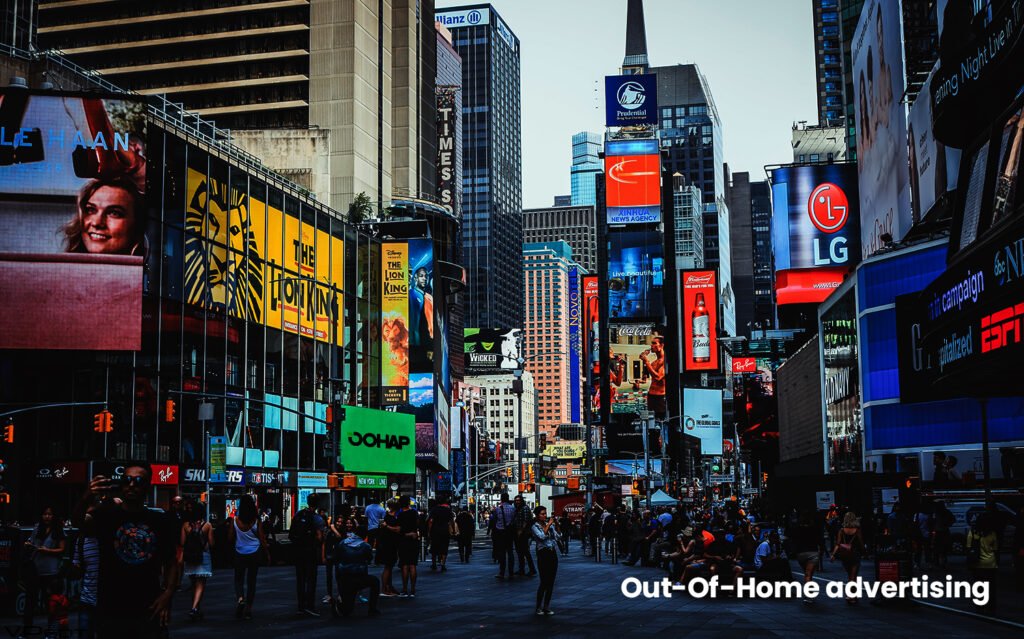
Proven benefits of outdoor advertising for businesses.
Regardless of when, where, and how an audience consumes their media, outdoor advertising can reach just about anyone. As one of the most valuable forms of advertising, OOH campaigns are an essential element of any strategic consumer acquisition effort. Perhaps more important than helping you reach more people, OOH advertising will also help you connect with consumers at the right time. While outdoor advertising is great for building brand awareness, it’s important to remember that outdoor advertising doesn’t always generate a direct response.
In a large-scale campaign, outdoor advertising will still be a profitable form of brand awareness advertising. Well-targeted OOH advertising can increase traffic, and encourage potential customers to purchase at the moment. Outdoor advertising is still a great way to build brand awareness for businesses, but direct action digital opportunities have taken the lead in advertising.
Outdoor advertising is embracing digital formats and has seen a surge in outdoor digital advertising that has grown. One of the reasons for this growth is that marketers are comparing outdoor advertising with other media formats and realizing that when used correctly, outdoor advertising is relatively inexpensive and has a higher ROI than other more traditional media formats.
This is where OOH offers ideal solutions to improve brand verification, connect with potential customers, provide demographic and geographic targeting, get real-time information about advertising campaigns, and improve the user experience. OOH can help you reach your audience at the right time and can be the missing piece you need to tie your existing campaigns together. When used correctly as part of a smart media strategy, outdoor advertising can have a huge impact on future campaigns and empower consumers to interact with your brand.
OOH, advertising is important because it allows brands to reach large groups of consumers with compelling images and powerful messages that read the same message at the same time. True and effective OOH advertising is also a proven media booster as it expands the reach and frequency of integrated campaigns and is the most effective driver of mobile, social and digital engagement. Outdoor advertising has proven and will continue to demonstrate that it is an essential channel in the marketing media mix.
Outdoor advertising helps to attract new customers who may be interested in advertising your products or your company’s services. Outdoor advertising can play a key role in increasing brand preference simply because it is one of the least intrusive forms of advertising. Many brands are choosing to use OOH media to push consumers to take action, which means advertisers can see the effectiveness of their campaigns in real-time.
Conclusion-
It’s time to start incorporating outdoor advertising into your marketing strategy now that you are aware of the facts regarding billboards. We have dispelled the numerous myths and misconceptions about OOH so that you have a clear understanding of what the world outside the house is like today and what value it can offer for companies of all shapes and sizes. Unfortunately, despite the growth of advertising, we still hear it far too frequently. By clearing these myths, we hope you’ll see that out-of-home advertising is a great approach to connect with your target demographic and accomplish your marketing objectives.
