
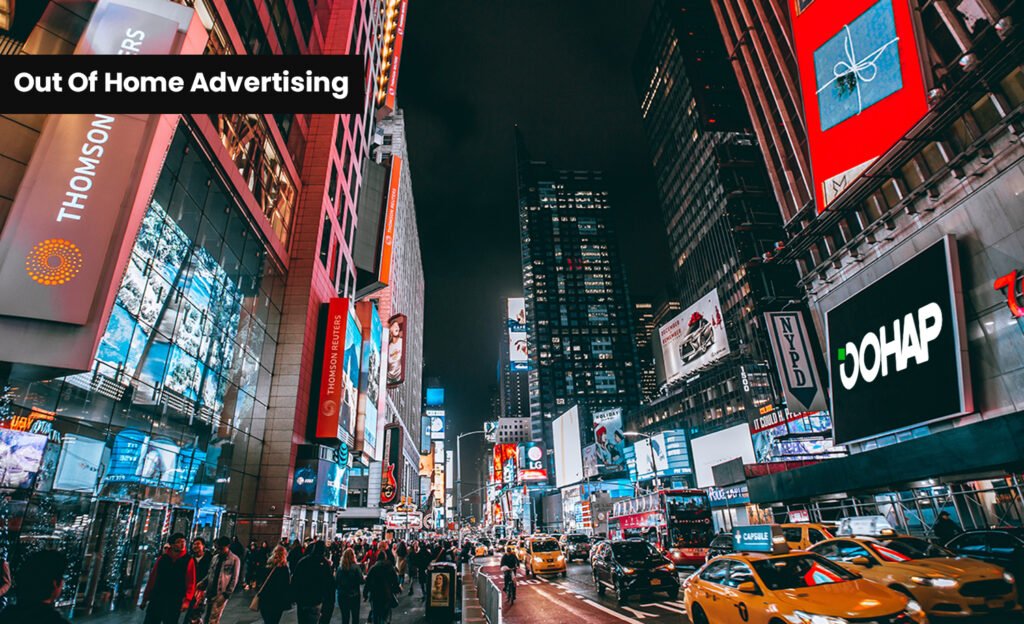
Outdoor Advertising is an amazing way to expose the targeted public to your brand. Being an excellent way to promote the brand, outdoor advertisement ads are a great marketing tool for businesses looking to reach large audiences. Not only does OOH advertising instantly broaden your reach and target, it can also impact your audience’s purchase journey and drive great engagement with your brand.
This factor gives OOH advertising tremendous potential for inclusion in any marketing mix, not just in branding ads. One of the best reasons to invest in OOH advertising is because it is cost-effective to reach large audiences and raise brand awareness. If you know that the design will be the key to getting your target audience, using OOH advertising could help you make a big impact. It can boost brand recognition, provide high-visibility advertising space, and is a valid way to reach your target audience in any market.
One of the most powerful aspects of the new technology world of OOH is advertisers’ ability to precisely target audiences. Recent investments in digital ad placement, data-driven audience targeting, and programmatic technologies are changing the landscape: giving advertisers access to proven digital ad technologies, like dynamic, context-relevant creative, targeting audiences by location and behavior, and making decisions based on purchasing.
Because outdoor ads are public, they are seen by all types of people, including those more difficult to reach, like employed professionals or lower-income consumers with limited access to more media or the internet. Consumers are more likely to remember an outstanding OOH ad than one in the hundreds of TV or digital ads that they see that day. In the past, out-of-home ads were used mostly in branding-marketing campaigns.
When you compare OOH ads’ Cost Per Impression with online brand awareness campaigns, radio ads, or other types of brand awareness, there is no doubt outdoor media advertisement is one of the most affordable options. When compared with other forms of advertising media, it is easy to understand why Out-of-Home Advertising is considered to deliver a lot of value for little money.
1. It’s a highly interactive and creative marketing tool
Outdoor Advertising has become a powerful medium to reach your target audience and increase brand engagement. Digital and Out-of-Home Media is changing ways to improve your digital marketing. As our society becomes increasingly technology-driven, many people feel out-of-home advertising is moving towards digital equivalents. Immersive marketing is getting more creative, unconventional approaches. Advertisements include images, punchlines, storytelling, offers, and case studies to attract more people to their ad campaigns.
There is no question the interactive possibilities are filtering through OOHs ad campaigns. Impressions from campaigns can be measured, and attribution is now possible – this makes OOH ads a powerful suite of tools for any marketing department. It has solved that problem, and it is now combined with the advances in digital, making it a powerful tool for advertisers and marketers. It allows advertisers to target the same people who repeatedly saw an OOH message through digital ads.
Out-of-home shows that sometimes, simpler creativity is more effective. Catering to marketers new to OOH advertising, compiling education e-books, guides, and articles, providing practical advice, direct insights, and best tips to plan, execute, and measure effective OOH campaigns.
2. Targets a large audience at the same time
Outdoor media such as billboards, digital billboards, public transportation ads and posters are designed to be seen from anywhere. Outdoor advertising has a wide reach and is visited by thousands daily. You can reach a large target audience with digital signage in high-traffic areas with outdoor advertising campaigns.
Reach is the total number of distinct consumers within a target audience exposed to an advertisement for a product or service. The traffic measurement system is percentage based; it is the percentage of your target audience who have seen your ad at least once in your campaign.
The more specific your target audience, the better your business can advertise and promote that audience, which can help you get more conversions. Tracking a more specific target audience can be a great way to identify new growth opportunities by breaking down the preferences of a larger audience, so you can see where your brand is making progress and where it’s lacking. The cost means that OOH can be successfully used to target most consumer segments if you take the time to understand your audience more deeply and target them effectively through channels like billboards and posters.
Outdoor advertising is a great way for any advertiser or marketer to build brand awareness and capture the attention of consumers. Outdoor advertising, as well as other channels, will expand reach, strengthen marketing campaigns, and drive consumer engagement with brands online and in-store, making out-of-home (OOH) one of the fastest-growing advertising media opportunities.
3. OOH drives online engagement
Out-of-home ads are the most effective offline media for driving activity on the internet. It finds a clear correlation between outdoor ads and consumers’ engagement online with brands. Outdoor advertisement drives shorter-term metrics like sales, not only longer-term factors such as brand awareness.
Outdoor campaigns boost online searches and social media activities more than traditional media, even banner ads on the internet. Drives many app downloads when controlling for advertising spending as TV, OOH ads drive consumers to download an app, scan QR codes, and increase campaign engagement. Outdoor advertising with consumers who are heavily engaged in search and social media results in increased website traffic and online activities. The power and effectiveness of OOH to trigger online consumer activation comes at a time when consumers are reporting higher levels of irritation about ad-sponsored content on digital media and feeling exhausted by their devices out of home act as a benefit to online surfers with relief in too much-sponsored ads and online campaigns.
4. Outdoor media is economical and time-saving
OOH offers brands inexpensive, nationwide exposure. Advertisers ought to take advantage of the channel’s extremely competitive pricing. Scalability and broad market coverage are two important advantages of OOH media, and utilizing them is a wise financial decision.
The trend of outdoor advertising to capture the share of traditional advertising media is expected to continue to support in the coming years. All these ads spend advancements that drive advertiser ROI will also help OOH capture a much larger piece of the media mix pie.
The majority of advertising funds are distributed between conventional and digital platforms. One of the most crucial determining factors is time and cost-effectiveness. Compared to big chains, small and local companies have less money to spend on advertising. Although most advertising budgets cannot be modified to include billboards, not everyone can saturate the market like the large players. They are fairly inexpensive, and the cost varies based on the market where the billboard will be located. They are often far less expensive than television, magazine, and newspaper advertisements. In terms of cost per thousand impressions, outdoor advertisements outperform digital ones.
5. Geofencing & Location data in outdoor media
Geofences are invisible geographic fences placed around a billboard or other OOH format. Using mobile-location data to exposure effects from outdoor advertising has been going on for a while. It is not just marketers who have seen a variety of verticals – from automotive, retail, travel, and even telecom — leverage the power of location data to measure outcomes across many verticals – starting with automotive OOH campaigns. For example, mobile location data helped digital marketers increase conversion rates and ROI from advertising campaigns in the targeted area.
Marketers who are running ads are using location data to achieve a variety of ad goals. Marketers utilize geofencing and mobile ads to target their audiences by their current location to serve ads in real-time or can use a person’s prior location to deliver ads at a later date. Marketers can use geofences as a means of geotargeting. For example- Customers will receive advertisements on their smartphone based on the geofence they were in after they pass in a particular area. Consider a consumer who sees a company’s billboard. They subsequently receive coupons/ offers related to the company services after checking a random app on their phone. Because consumers have previously seen the billboard, they are more likely to click to interact with the coupon and may engage as a result.
As an advanced marketing tool, companies often use geofencing to target customers with timely ads at specific locations in real time. Hyperlocal geofencing is a mobile location-based service that uses GPS coordinates that are even more accurate to target banner ads on any mobile device, whether within an app or a Web browsing session. Geofencing uses GPS or IP technologies to create a virtual border around a geographic location.
Mobile location data provides an actionable understanding of where people are, and OOH media providers can leverage that data to provide timely, relevant messages to their audiences. The technology has location-based data-driven capabilities that enable advertisers and inventory owners to leverage real-world data to plan, purchase, retarget, and measure their home media.
6. OOH gives maximum ROI with minimum efforts
OOH, advertising increases sales growth and brand recognition, which are the main drivers of this ROI ripple effect. For instance, the return on investment of digital search rises when customers are driven to the brand’s website for further details. Direct response CTAs on billboards, bus wraps, and other advertising media attract consumers to other platforms and boost interaction with branded content.
On average, there are product sales for every penny spent on OOH advertising. Media such as Radio, print and digital display ads can earn a large amount of campaign in the average media set, but outdoor advertising provides a higher ROI.
Whether raising general awareness or targeting specific audiences, outdoor advertising allows brands to communicate more effectively with consumers with accountability and achieve higher ROI. Today’s out-of-home advertising offers creative options for sharing your message to businesses. The key to OOH advertising success is getting your ad to the right people at the lowest CPM to get the highest ROI.
Conclusion-
Out-of-home advertising is big and blooming. It allows you to target a maximum audience through its multiple advertising options on Screen (Billboards), Print (Classifieds/Transit ads) and Radio. OOH is helping advertisers get their message across and reach out to the maximum audience at their doorstep. Radio ads are another way of reaching the audience at the right time and in the most economical manner. These ad campaigns can be completely personalized with various targeting choices like OS, Age group, Demographics, Gender and much more.
