
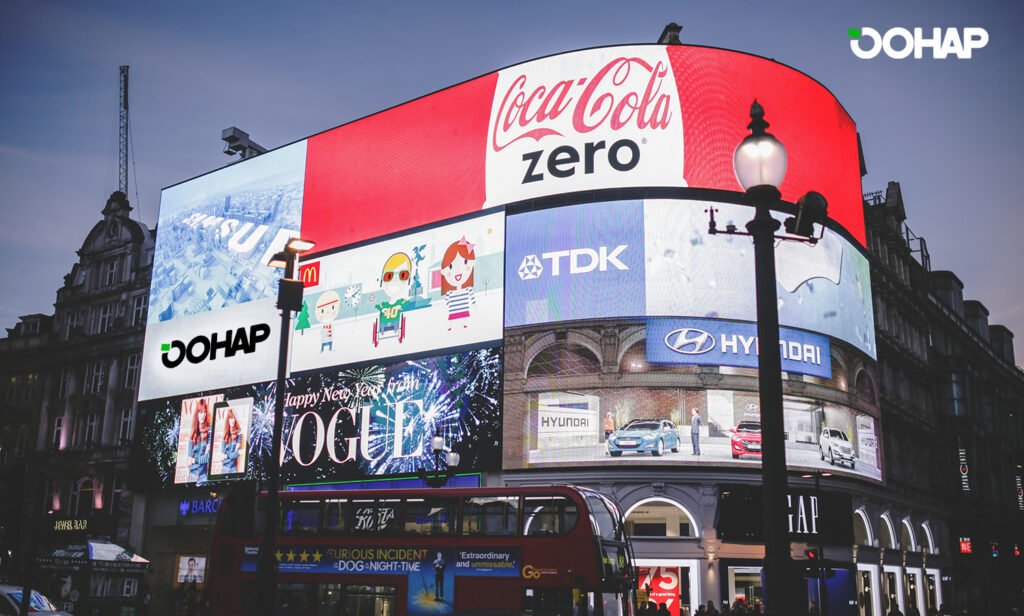
Focusing on brands within campaigns can have tremendous benefits for your marketing ROI. There is plenty of evidence to suggest that outdoor campaigns can make significant positive impacts on metrics like brand awareness and brand recall. Impressions from the campaigns can be measured, and now, attribution is also possible – this all makes OOH advertising a powerful toolkit for any marketing department. With the right measurement in place, advertisers can track results and use the insights from campaigns and audiences to drive actionable strategies. With the right marketing strategy you can use techniques to boost campaign ROI .
As with any type of marketing campaign, thorough planning is critical to ensure that OOH ads are getting maximum return. Like with any marketing channel, begin by choosing your goals for the OOH ads.
Introduction
As with any marketing channel, your strategies to implement an OOH ad campaign should be tied to a particular marketing objective. Once you decide on the messaging you want to promote, it is time to select the appropriate OOH locations to place the ads. OOH is tried and tested, and when done well, it can boost your business greatly. Email ads may drive immediate action (like sales). In contrast, OOH or TV ads can help cement the value of your brand in consumers’ minds, encouraging them to talk about it and spreading awareness.
Not only does becoming an influencer affect ROI and marketing budgets, but spending money on ads that do not provide value to your customers may cause negative views about your brand.
This means advertisers can run high-impact, highly visual campaigns that grab consumers’ attention and enable brands to make their messages stand out. By understanding, advertisers can serve dynamic ads that best fit a consumer’s needs at a given moment.
1.Why are marketers adopting out-of-home campaigns for advertising?
Marketers can target the places to spend the most money, according to the value generated by customers, and determine which channels are the most likely for them to be engaged.
1.Using data, enables to reach the right audience at the right time with an OOH campaign, building brand awareness, driving traffic to the web or offline, and providing an unobstructed customer experience. Instead of casting a wide net across a marketplace, you can leverage fine-grained audience data to discover, reach, target, and engage consumers with OOH ads more precisely than ever.
2. As an integral part of any marketing strategy, advertising can help reach the perfect audience with a targeted, precise message. Reach your target audience through Facebook ads, which are included on their feeds, ensuring that your products reach the right audiences. You can partner with influencers within your niche to produce star-studded content that targets your audience.
3. Real-time data also helps you schedule, book, and purchase media more purposefully, optimizing for high-performing locations and maximizing return on investment. Tracking real-time metrics behind your campaigns allows you to make smaller adjustments in your social media marketing strategy instead of making large, time-consuming changes.
2.Ways to boost out of home advertising campaigns.
There are different ways and techniques that can be used for your outdoor advertisement campaign and helps to increase ROI for your business.
In the blog, further you can see how out-of-home advertisement can boost campaign ROI:
2.1 User predictive analytics
Data-driven marketing leveraging personalized targeting of customers can increase business investment returns. Companies of all sizes can leverage customer data analytics to boost campaign ROI. Predictive analytics can use various data sources to uncover customers’ pain points, predict needs, and build offers tailored to particular customer segments.
a. Predictive analytics- Helps you optimize marketing strategies by enabling you to pay attention to needs and better invest energy and time. You can also use predictive analytics for prioritizing leads by figuring out which customers are the best fit to convert.
For example, audience segmentation improves the return on investment of your marketing expenditures. In addition to providing greater channel control, the data-driven investment includes analytics that enhances customer segmentation, messaging, personalization, and targeting techniques like similarity modeling.
b. Location data- Marketers can leverage travel patterns to build profiles of customers. Boost allows brands to link location data from fleets, build targeted audiences, expand reach for OOH advertising placements, and measure performance based on individualized conversion goals. The most effective strategies to boost campaign ROI for outdoor brand’s email marketing campaigns are not shots in the dark: They are developed from real data drawn from actual customers and other outdoors enthusiasts. Adopting strategies that emphasize creativity as much as data for campaigns to be highly conversion-focused on all of your marketing channels will ultimately yield the biggest return on investment.
2.2 User-friendly content
The right message, delivered at the right time to the right person, has a way of cutting right through the noise to deliver much better brand recall. Advertisers with a single view of their marketing can optimize to get the right message to the right person at the right time on their consumer’s journey toward a purchase, driving higher total ROI than is likely with any individual channel.
a. By advertising in spaces frequented by your target markets, you ensure the right messages get in front of the right people. You reach more people at the right places and time, which must be the first consideration in today’s highly competitive markets. Using the latest technologies and data science, you can reach the right audience at the right time with OOH campaigns, building brand awareness, driving traffic to the web or offline, and providing seamless customer experiences.
b. OOH helps ensure effective advertising campaigns, reaching a targeted audience at a lower cost per impression than online or broadcast. If you are doing a manual negotiation for outdoor advertising, be sure to work with a qualified trade associate to help determine what media is reaching your audience.
One that delivers the right messages to your best customers on various channels, at the time and place they want to engage. For many businesses, getting marketing decisions right is no small task. However, it can have an enormous impact on their bottom line.
2.3. The right message at the right time
With outdoor advertising at parks, indoor/outdoor areas, and sporting venues, you get the opportunity to capture captive audiences who may be difficult to reach in other ways, whether it is urban or rural markets.
a. By using anonymized mobile device IDs, advertisers also take advantage of enhanced attribution for measuring OOH performance and growing points of interest from the movements and behaviors of audiences across any market.
For example, mobile location data helped digital marketers increase conversion rates by 60% and ROI for their ad campaigns. Digital marketing is not an “either/or” strategy. Instead, businesses need to mix both traditional and new media. Using creative management platforms to create ads easily on the web, which can be scalable to multiple publishers, is critical.
b. For campaigns to translate across all of your marketing channels, adopting strategies that emphasize creativity and data will yield better returns in the end. To increase your total ROI for the whole business operations, you need to develop content beyond the norm, followed by a social media marketing promotional plan to make it stick.
c. Prioritizing content effectively improves your ROI since businesses are using content marketing to increase their engagement, with blogs, in particular, being more likely to lead to positive ROI. When tracking ROI for social media channels, most marketers refer to their content development costs, deployment costs, and ad costs.
2.4. Setup goal and target audience
Start setting clear goals for your marketing campaigns on various channels to get as much ROI as possible within your industry to align your efforts toward reaching those goals.
. A well-defined process of experimentation involves getting a handle on timing, budget, target market, and ideal audience parameters, which are essential for helping you execute effective campaigns. You can also employ fine-grained audience segmentation to track how a campaign performs among the targeted audience, defined by behavioral, geographical, or demographic data.
2.5. Measure metrics, KPI's and then plan your next campaign
Measuring ROI from your marketing campaigns helps you discover what is working and what is not so that you can expand or optimize your effectiveness. Remember,
the metrics used to measure the ROI for your various marketing channels will vary depending on your goals and objectives
a.By measuring the ROI of your marketing, you will see how well each campaign is performing on the particular metrics that are important for your company. Your marketing team knows exactly how the campaign’s performance will be measured, so the marketing team can focus on finding ways to improve those metrics. To justify your marketing budget, leverage various metrics related to the campaign’s goals.
b. Establishing and measuring success in your marketing campaigns involves using KPIs. Digital marketing KPIs are quantitative metrics that are relevant to your goals.
KPIs in marketing reveal how well a particular project and campaign is performing, helping you to decide if it is worth continuing or not.
c. Whatever KPIs you decide on need to be concrete and measurable so that you can track how well the campaigns are performing. Marketing funds should be spent on campaigns that produce positive results, and KPIs help you determine which campaigns are right for focus.
d. Marketers measure and optimize their marketing effectiveness, sales, and engagement, providing an integrated view of the success of a campaign across every point of contact. Marketers can monitor and isolate OOH, attribute online and offline conversions directly, measure real-world ROI with rigorous lift-off analytics, compare relative unit performances, and optimize campaigns to drive better results over time.
Conclusion
More than ever, advertisers must be able to monitor and improve their out-of-home initiatives due to the explosive proliferation of new media. Advertisers may evaluate performance and use useful campaign and audience information for strategic planning with the help of accurate OOH measurement. The more money your advertisements can bring in, the more effective they will be.
